

Yes. San Antonio Water System reports local hardness at 15 to 20 grains per gallon, which the Water Quality Association classifies as very hard — roughly twice the mineral load of a typical American city. At that level, scale accumulates on fixtures, inside appliances and on water heater elements faster than manufacturers design for. Silverback Plumbing and Drain sizes and installs whole-home water softeners across San Antonio to your household’s actual demand rather than whatever is on the shelf.
San Antonio’s hardness as reported by SAWS, against a national average nearer 7 to 10 grains per gallon. Everything below follows from that one number.
How hard water announces itself
-
White crust on fixtures
Chalky calcium deposits around faucet bases, showerheads and drains, straight out of the Edwards Aquifer.
-
Skin tight after a shower
Minerals bind with soap so it never fully rinses, leaving a film on skin and hair regardless of what product you use.
-
Spotted glassware
Cloudy glasses out of a dishwasher that is working perfectly well. The residue is what the water left behind as it dried.
-
Pressure falling over years
Scale narrows the bore of supply lines and appliance connections, so flow drops at every fixture at once rather than one.
-
A water heater that failed early
Sediment on the tank floor insulating the burner, forcing the steel to run hotter for the same shower.
-
Appliances not making their rated life
Dishwashers, washing machines and ice makers with scaled elements and valves, retiring years before they should.
What a water softener actually does
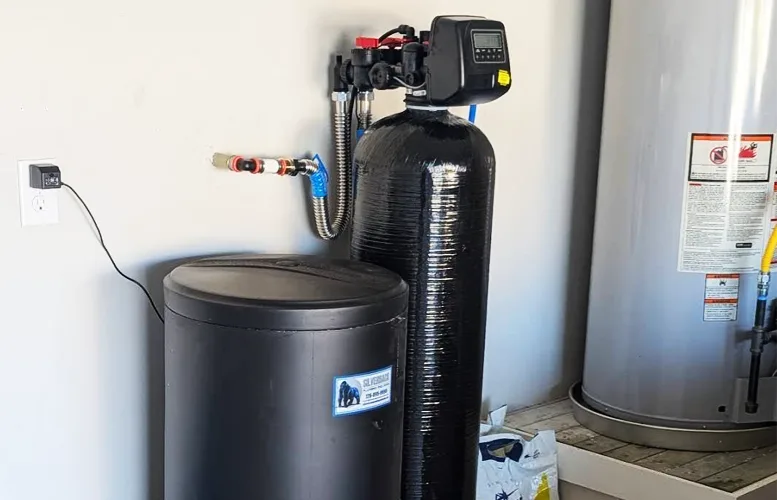
It does not filter minerals out; it trades them out, through ion exchange. Hard water passes through a tank of negatively charged resin beads. Calcium and magnesium carry a positive charge and are drawn onto the beads, which release sodium or potassium in exchange. What leaves the tank is water with the hardness minerals removed, at the same pressure and flow you had going in. Periodically the system flushes the resin with brine to reset the beads, which is the regeneration cycle you occasionally hear at night.
Salt-based or salt-free, at this hardness
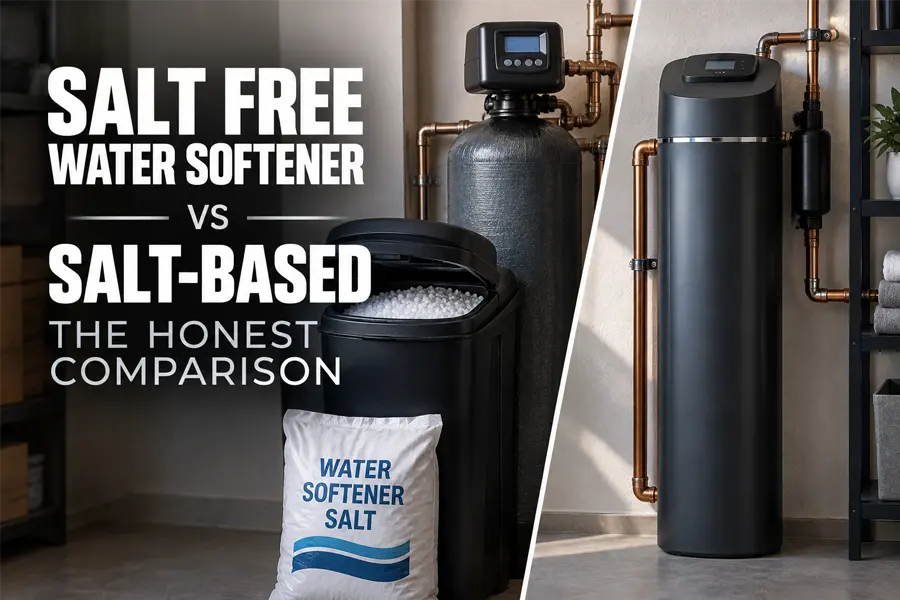
Salt-free systems — descalers or conditioners — change the structure of the minerals so they are less inclined to stick, but the minerals stay in the water. At 15 to 20 grains that distinction matters.
| Salt-based softener | Salt-free conditioner | |
|---|---|---|
| How it works | Ion exchange removes hardness minerals from the water | Crystallises minerals so they adhere less readily |
| Effective at 15–20 GPG | Yes — this is what it is designed for | Limited. Performance falls away above roughly 10 to 12 GPG |
| Maintenance | Salt every six to eight weeks for most households | No salt, and no measurable softening at this hardness either |
| Best fit | San Antonio and anywhere else on Edwards Aquifer supply | Mildly hard water, typically under 10 GPG |
For water here, we recommend salt-based systems. Conditioners have a real place in cities with moderate hardness; this is not one of them.
What size water softener your household needs
Grain capacity is daily water use multiplied by hardness. At San Antonio’s numbers that works out roughly like this:
| Household | Typical daily use | Daily grain load at 17 GPG | Capacity to look at |
|---|---|---|---|
| 1–2 people | 150–200 gal | 2,550–3,400 grains | 32,000 grain |
| 3–4 people | 250–350 gal | 4,250–5,950 grains | 48,000 grain |
| 4–6 people | 350–500 gal | 5,950–8,500 grains | 64,000 grain |
| 6+ people or a large home | 500+ gal | 8,500+ grains | 80,000 grain or dual tank |
Treat these as starting points. We measure your home’s actual usage and test the incoming water before specifying anything — well properties and some areas within the SAWS footprint differ from the reported average, and an undersized system regenerates too often and wears out early.
Where a water softener goes, and what the spot has to allow
Most San Antonio homes have a plumbing loop already stubbed out for this, usually in the garage or on an exterior wall near the meter side of the house. If yours has one, the water softener drops straight into it. If it does not, the water softener has to be tied into the main line ahead of every branch, and that is what decides where the equipment can physically sit.
Three things have to be true of the spot, whichever one it turns out to be. There has to be a drain within reach for the regeneration discharge, air-gapped so nothing can siphon back into the supply. There has to be power for the control head. And there has to be room to lift a forty-pound bag over the brine tank without turning sideways, because somebody is going to do that several times a year for the next decade.
Outdoor installations are common here and they work, but they are not free of consequence. A water softener mounted on a west-facing wall takes the full afternoon sun, and resin ages faster warm than cool. More to the point, the February freezes have split brine lines and cracked control heads on units put in with no insulation and no thought given to a hard freeze. If outside is the only workable position, the water softener wants a cover and the line wants wrapping.
What it saves on everything else
| Without a softener | With one | |
|---|---|---|
| Water heater life | 6 to 8 years is common here | 12 to 15 years |
| Sediment flushing | Once or twice a year, and it matters | Less often, and less comes out |
| Faucet aerators | Cleaning or replacing every 12 to 18 months | Rarely an issue |
| Dishwasher and washing machine | 7 to 9 years typical | Close to their rated life |
| Fixtures | Visible scale, constant scrubbing | Stay clean with ordinary cleaning |
A water heater replacement in San Antonio currently runs $1,200 to $2,800 installed. A whole-home softener at $800 to $2,200 has paid for itself the first time it adds five years to that one appliance, and it is protecting every other water-using machine in the house at the same time.
With a tankless heater, softening stops being optional
Tankless heaters work by driving water across a heat exchanger with very tight internal passages. At 15 to 20 grains per gallon those passages scale up quickly, and a scaled exchanger loses output long before it fails outright: the shower that used to run hot now runs warm at the same setting. Most manufacturers require annual descaling on hard water, and several make softened supply a condition of the warranty, so an untreated unit can fall out of cover well before it falls out of years.
Put a water softener ahead of it and that maintenance drops from a yearly necessity to a periodic check. If you are weighing a tankless upgrade and a water softener as two separate purchases, they are really one decision — and softening second is the expensive order to do it in.
Water softener installation and repair pricing
These are typical installed costs in San Antonio. Final pricing depends on capacity, plumbing access and whether existing connections need updating — and it is confirmed on site before work begins.
| Service | Typical range |
|---|---|
| Whole-home installation, 32,000–48,000 grain | $800–$1,600 installed |
| Whole-home installation, 64,000+ grain | $1,400–$2,200 installed |
| Resin bed replacement | $200–$500 |
| Control valve repair or replacement | $150–$450 |
| Brine tank repair or replacement | $100–$350 |
| Annual service inspection | $80–$150 |
A box-store unit against an installed system
The hardware on a shelf at a home centre and the hardware a plumber fits are often the same class of equipment. What differs is everything around it. A water softener sized by the picture on the box is sized for average American water, which is roughly half the hardness of what SAWS delivers here, so an undersized water softener regenerates constantly, works through salt, and still lets hardness past at peak demand.
The installation is where the difference actually shows up. Tying into the main ahead of the branches, fitting a three-valve bypass so the house keeps water while the system is serviced, running an air-gapped drain, and pulling the plumbing permit the City of San Antonio requires — none of that is easy to retrofit once a water softener is already sitting on a slab with flexible connectors running to it. We get called out to correct that arrangement more often than we get called to a failed water softener.
Five questions worth asking before you sign anything
- What is my measured hardness, and what grain capacity does that put the water softener at?
- Is the control head metered, or is it on a timer?
- Is a three-valve bypass included, so the house keeps water while the water softener is serviced?
- Where does the regeneration water discharge, and is it air-gapped?
- Who pulls the permit, and does the quoted price for the water softener include it?
Any installer should answer all five without hesitating. If the answer to the first one is a number that arrived before anybody tested your water, the water softener being quoted is a guess.
What water softener installation day involves
- We test incoming hardness and measure household usage to fix the right grain capacity.
- We tie the system into the main supply ahead of any branch, so the water heater is protected too.
- We run the regeneration drain line and connect the brine tank.
- We program the cycle, test the outgoing water, and confirm it is softening before we leave.
It is a single visit with no demolition. Most people notice the difference — less soap needed, no new scale, cleaner glassware — inside the first week.
Salt, regeneration and the running cost
A water softener works by swapping hardness minerals onto a resin bed and then rinsing that bed clean with brine. The rinse is the regeneration cycle, and how it gets triggered is the single biggest factor in what the water softener costs to run. A timer head regenerates on a schedule whether the house used any water or not, which over a week away is pure waste. A metered head counts gallons and regenerates when the bed is genuinely spent. Every water softener we install is metered.
Salt type matters less than people expect and more than not at all. Solar salt and evaporated pellets both do the job; rock salt carries more insoluble matter and leaves a sediment in the brine tank that somebody eventually has to shovel out. Potassium chloride is the option for a household restricting sodium, at roughly three to four times the cost per bag.
The fault people meet most often is a salt bridge — a hard crust that forms across the tank so the salt sitting above it never reaches the water below. The tank looks full, the water goes hard, and nothing appears to be wrong. Breaking the crust with a broom handle clears it; keeping the tank under about two-thirds full stops it forming again.

If your water softener has stopped working
When hard water symptoms come back on a running system, it is usually one of three things: a resin bed that no longer holds the charge, a failing control valve, or a timer that has stopped triggering regeneration. Age and repeat frequency decide the rest.
| Situation | The usual call |
|---|---|
| Under 5 to 7 years, one fault | Repair |
| Symptoms returning after a previous repair | Inspect — most often the resin bed. |
| 8 to 10 years with recurring issues | Replace |
| Salt consumption up, softening down | Resin swap, or replace depending on age. |
| 10 years or more | Replace Resin and valve are both at end of life. |
- White buildup reappearing on faucets you had stopped cleaning.
- Salt disappearing faster with no change in household usage.
- Pressure dropping downstream of the water softener specifically.
- The brine tank not drawing down during regeneration.
- The system not regenerating on its programmed schedule.
What softening will not do for you
A water softener treats hardness. That is the whole of its job, and it is worth being plain about what people expect it to fix that it does not touch.
It does nothing about the chlorine or chloramine taste SAWS uses for disinfection — that needs carbon filtration, a different vessel doing a different job. It does not remove sediment, and in a house with a sediment problem the unfiltered grit shortens the life of the water softener control valve. It has no effect on bacteria. And on a private well it will not touch iron staining, sulfur smell or nitrate, all common out in the Hill Country and none of them identifiable without a lab result.
Where one of those is the real complaint, whole-home water filtration or well water treatment is the answer — sometimes alongside a water softener rather than instead of one.
Work is carried out by licensed plumbers under our Responsible Master Plumber, license RMP-43333, issued by the Texas State Board of Plumbing Examiners. You can verify that license yourself.
What San Antonio homeowners say
Reviews pulled live from our Google Business Profile, not retyped here.


Questions homeowners ask us
Is San Antonio water hard enough to need a water softener?
Yes. SAWS reports 15 to 20 grains per gallon, which the Water Quality Association classifies as very hard, against a national average of roughly 7 to 10. At that level scale accumulates on fixtures, inside appliances and on water heater elements faster than in most of the country, which is why water softeners are one of the most common plumbing improvements in the city.
How much does installation cost in San Antonio?
Typically $800 to $1,600 for a 32,000 to 48,000 grain system and $1,400 to $2,200 for 64,000 grain and above, including equipment and labour. Capacity is the main variable. You get a firm price before work begins.
What size do I need?
At local hardness, roughly: 32,000 grain for one or two people, 48,000 for three or four, 64,000 for four to six. We measure your actual daily usage and test incoming hardness before specifying, because a system that is too small regenerates too often and wears out early.
How long does a water softener last here?
Ten to fifteen years with normal maintenance. The resin bed, which does the actual work, often needs replacing at eight to ten years in water this hard because it processes a much higher mineral load than it would elsewhere.
Salt-based or salt-free?
Salt-based, for San Antonio. Salt-free conditioners make minerals less adherent but do not remove them, and their effectiveness drops off above roughly 10 to 12 grains per gallon. At the hardness SAWS reports, only ion exchange actually prevents scale forming inside pipes and appliances.
Will it extend my water heater’s life?
Substantially. A conventional tank here commonly reaches 6 to 8 years before scale costs it enough efficiency to justify replacement. With the minerals removed upstream, the same unit can run 12 to 15. It also reduces how often the tank needs flushing.
Is softened water safe to drink?
Yes. A salt-based system adds a small amount of sodium, typically 20 to 40 milligrams per litre depending on incoming hardness, which is well within ordinary dietary limits and not noticeable in taste. Potassium chloride can be used in the brine tank instead if you would rather avoid the sodium entirely.
How often does it need salt?
Every six to eight weeks for most San Antonio households. A correctly sized system regenerates every seven to ten days. If you are topping up every two or three weeks, the system is probably undersized or the cycle is set wrong.
Does it need a licensed plumber?
The plumbing connections do. Tying into the main supply, fitting a bypass and running the brine discharge line are all licensed plumbing work in Texas. The appliance itself is equipment; getting it connected to the house is not.
Do I need a permit for a water softener in San Antonio?
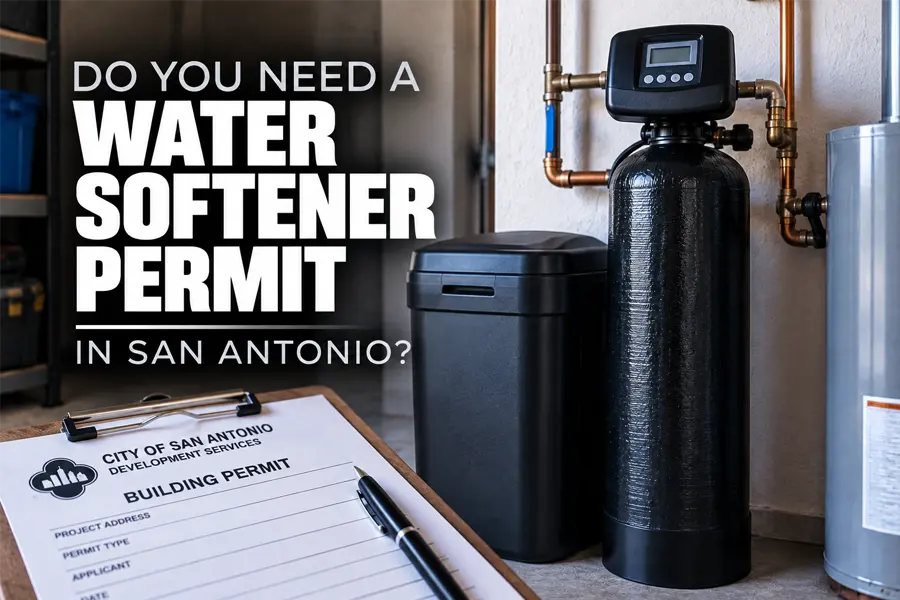
Yes. The water softener connection to the potable supply is permitted work and a licensed plumber has to pull it. The permit is inexpensive, and it is what leaves you a record that the installation was inspected — which is the part that matters at resale.
Can I soften only part of the house?
You can, and plenty of people do when irrigation shares the same supply. The usual arrangement leaves the hose bibs and the sprinkler line on hard water, since plants take no benefit from softened water and there is no reason to pay to treat it.
Will a water softener lower my water bill?
Not directly. What it lowers is the replacement cost of everything the water passes through on its way around the house. A regenerating water softener does use some water itself, in the region of 40 to 60 gallons a cycle, so expect the bill to hold steady rather than fall.
Hard water damage is cheaper to prevent than undo.
We will test what is actually coming into your house, size the system to your household, and give you the number before anything is fitted.