

A gas fireplace gets used perhaps twenty evenings a year in San Antonio and then sits untouched for eleven months. That usage pattern is exactly why they fail on the first cold night — components corrode, spiders nest in pilot orifices over the summer, and nobody finds out until the temperature drops and the burner will not light. October is the sensible month to have it looked at. November is when everyone else calls.
If you can smell gas near the gas fireplace
- Leave the building. Do not switch anything on or off, including light switches, and do not use your phone indoors.
- Once you are outside and clear, call CPS Energy’s 24-hour line at (210) 353-4357.
- Call 911 first if the smell is strong or anyone feels lightheaded.
- Do not go back inside to look for the source.
Call us once the property has been cleared and we will find and fix what caused it.
Vented, direct vent or vent-free — knowing which you have
Three systems sit behind the glass in San Antonio homes, and they behave differently enough that the first question on any gas fireplace call is which one is in the wall.
A B-vent or natural vent unit draws combustion air from the room and sends exhaust up a flue. It is the oldest arrangement and the least efficient, because a good deal of the heat goes up with the exhaust. A direct vent gas fireplace is sealed behind fixed glass and uses a coaxial pipe to draw outside air in and push exhaust out. It is the arrangement we fit most often now: nothing from the firebox enters the room, and the glass front is a structural part of the system rather than a decoration.
Vent-free units have no flue at all and put their combustion products into the room. They are legal in Texas and they are not permitted in some other states, which tells you most of what you need to know. If you have one, a working carbon monoxide alarm in that room is not optional, and a vent-free gas fireplace should never be the only heat source in a bedroom.
Opening the glass on a direct vent unit while it is running breaks the seal it depends on. If yours has clips or latches, they are holding a pressure boundary, not a picture frame.

What we get called out for
-
The pilot will not stay lit
Usually a failing thermocouple or thermopile — the sensor that tells the gas valve the pilot is actually burning. When it weakens, the valve closes as designed and the pilot dies.
-
Pilot lights, burner does not
Points at the gas valve, the wall switch or remote receiver, or a thermopile no longer generating enough voltage to open the main valve.
-
No ignition at all
On electronic ignition units this is often the igniter, the control module, or a tripped safety interlock rather than a gas supply problem.
-
Delayed ignition with a thump
Gas accumulating before it lights, usually from partially blocked burner ports. Worth dealing with promptly rather than living with.
-
Soot, or yellow flames
Incomplete combustion, often from incorrect log placement, a blocked vent, or a poor air-to-gas mixture. It means the gas fireplace is not burning cleanly.
-
A gas odour near the gas fireplace
A connection, valve or line fault. Treat it as the box above describes rather than as something to schedule for next week.
Why this is a licensed plumber’s job in Texas
Running, altering or repairing gas piping in Texas is plumbing work, regulated by the Texas State Board of Plumbing Examiners. That matters for two practical reasons beyond compliance. Unpermitted gas work is a routine finding during a home sale inspection and a routine cause of a delayed closing. And homeowner’s insurance carriers have been known to contest claims arising from gas appliance work carried out by someone not licensed to do it.
Worth asking any contractor: is the gas connection itself in their scope, and under whose license? Some gas fireplace and hearth specialists install the gas fireplace but subcontract or simply omit the gas line work — which is the part that needs the license.
The millivolt system, and why the pilot is usually the story
A standing-pilot gas fireplace generates its own electricity. The pilot flame heats a thermopile, the thermopile produces a few hundred millivolts, and that tiny voltage is what holds the gas valve open and lets a wall switch work. It is why these units keep running in a power cut, and it is also why they fail in one particular way.
As a thermopile ages its output drops. A healthy one reads somewhere around 350 to 750 millivolts open circuit; below about 300 the valve starts refusing to hold, and the symptom is a pilot that lights, burns steadily for thirty seconds, and then goes out the moment you release the knob. People read that as a gas supply problem. It is almost always a component reaching the end of its life, and it is an inexpensive part.
The thermocouple is the smaller safety device that shuts gas off if the pilot goes out, and it fails the same way. Either can be tested with a meter in a couple of minutes, which is why a gas fireplace that will not stay lit is usually diagnosed before anyone has taken anything apart.
The other common cause is a pilot orifice partly blocked, which brings us to the spiders.

Annual service, and why spiders are the reason
The single most common cause of a gas fireplace that will not light after a long summer is a pilot orifice partly blocked by web or debris. It is a genuinely trivial fault that reliably strands people on the first cold evening of the year, which is also the evening every plumber in the city is booked.
- Pilot assembly and orifice cleaned and checked.
- Thermocouple or thermopile output measured rather than guessed at.
- Gas pressure verified at the valve.
- Burner ports inspected and cleared.
- Log placement checked against the manufacturer’s diagram — it affects both flame appearance and sooting.
- Venting, glass gasket seal, and a leak check on accessible connections.
Logs, embers and why the flame looks wrong
The log set in a gas fireplace is not decoration that can be arranged to taste. Each log sits in a moulded position that keeps it clear of the burner ports, and moving one into the flame path is the most common cause of black soot on the glass and on the log faces.
If yours has started sooting, look at whether anything has been shifted — by cleaning, by a previous service, or by somebody who thought it looked better rearranged. Correcting the placement usually fixes the sooting entirely, and it is the first thing we check because it costs nothing.
The glowing ember material at the base is a consumable. It degrades, it gets vacuumed up during cleaning, and a gas fireplace with bare burner ports and no ember bed looks flat and blue rather than full. Replacing it is part of an annual service.
One rule worth stating plainly: only the manufacturer’s log set belongs in that firebox. Logs from another model change the flame pattern and can cause incomplete combustion, and in a vent-free unit that has consequences beyond appearance.
Standing pilot or electronic ignition
If your gas fireplace has a small flame burning all year, it has a standing pilot. It is simple, it is reliable and it costs a few dollars a month in gas doing nothing for eight months of the year in this climate. Plenty of people shut the pilot off in April and relight it in November, which is sensible and is also why the first cold snap produces a run of calls.
Intermittent pilot ignition lights the pilot only when heat is called for, and it needs power to do it. Most systems carry a battery backup so the gas fireplace still lights when the electricity is out — those batteries are in the control compartment behind the lower louvre, and a unit that has simply stopped responding to the remote is very often a flat backup battery rather than a fault.
Remote receivers sit in the same compartment and they do fail, usually after a summer of heat. Before assuming the worst, try the manual override switch on the valve: if the gas fireplace lights that way, the problem is the receiver or the handset, not the gas fireplace.
New installations
| Type | What to know |
|---|---|
| Direct vent | Sealed combustion, drawing air from outside and venting out. The usual choice for a new install — safest and most efficient — but it needs an exterior wall or roof route. |
| Vent free | No flue required, so placement is flexible, but it puts combustion moisture into the room and is restricted or prohibited in some jurisdictions and room types. Check before committing. |
| B vent | Vents through an existing vertical flue and draws combustion air from the room. Usually only sensible where a suitable chimney already exists. |
| Gas log set in an existing masonry firebox | The most common conversion here. Needs a gas line run to the firebox and a damper stop fitted so the flue cannot be fully closed. |
Our scope on a new install is the gas side: sizing and running the line from the meter or an existing branch, fitting a shutoff within reach of the gas fireplace, pressure testing, connecting the gas fireplace and handling the permit. Sizing matters more than people expect — a line already feeding a range, water heater and dryer may not carry another appliance without being upsized. If your project involves new gas elsewhere at the same time, that sits with gas line installation and repair.
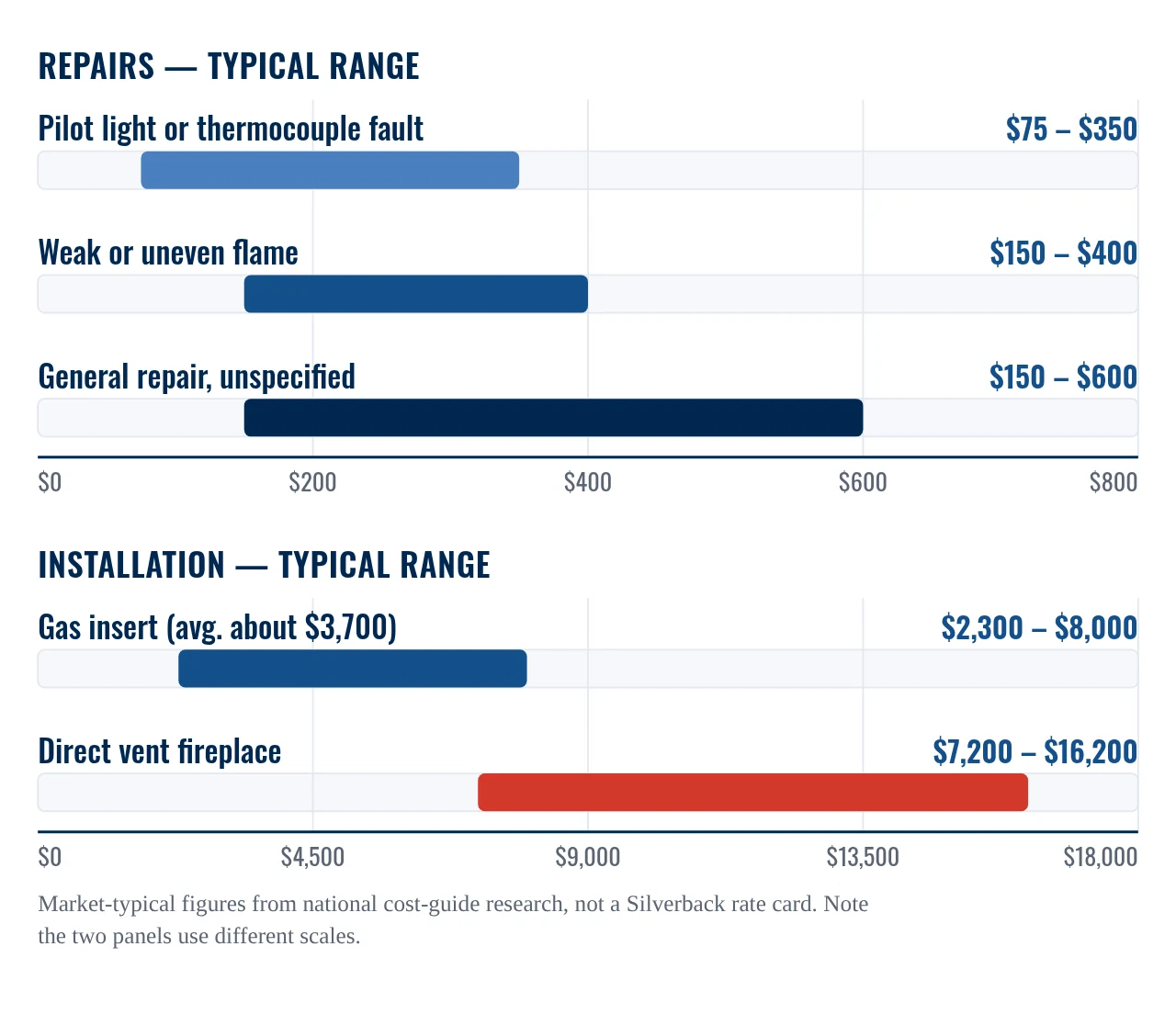
What it costs
- Repair or installationA repair is a diagnostic plus parts, and thermocouple or thermopile replacement sits at the lower end of that. A new installation is a different order of job entirely.
- Vent typeDirect vent needs a route through an exterior wall or roof. A log set into an existing masonry firebox usually does not, which is why the two quotes differ so much.
- How far the gas has to runPriced largely by distance and by what the pipe has to pass through. Whether the existing line needs upsizing to carry another appliance is the common surprise.
- PermitMost new gas work requires one. We pull it as part of the job rather than leaving it with you, which also puts the work on record for when you sell.
We quote before the work starts. We also wrote up local pricing in more detail: what gas fireplace installation and repair actually costs in San Antonio.
Glass temperature, barrier screens and carbon monoxide
The glass front on a direct vent unit reaches temperatures that will cause a serious burn in well under a second, and it stays hot for a long time after the fire is off. Since 2015 every new gas fireplace has been required to ship with a barrier screen for exactly this reason. Units installed before then usually have none, and a retrofit screen is available for most models — worth fitting in any house with small children or anyone unsteady on their feet.
Carbon monoxide is the other safety item and it is not a gas fireplace problem so much as a maintenance one. A correctly working sealed unit puts nothing into the room. A blocked flue, a cracked heat exchanger on an older vented model or a vent-free unit in an under-ventilated room can all change that, and CO has no smell. An alarm on the same floor is the answer, and it is cheap.
If you ever smell gas near the gas fireplace, do not operate any switch, get everyone outside, and call CPS Energy on (210) 353-4357 before you call us.
Gas gas fireplace service across San Antonio and the Hill Country
We service and install across San Antonio, Helotes, Boerne, Bulverde, Schertz, Stone Oak and Somerset. Gas gas fireplace work in Texas is licensed plumbing work, so the person who arrives holds the licence that covers it and pulls the permit where one is required.
Bookings run heaviest in the fortnight either side of the first cold front, which is also when a gas fireplace that has sat idle since March discovers it has a blocked pilot orifice. Servicing in September or October rather than on the first cold evening is the difference between a scheduled visit and a wait.
Work is carried out by licensed plumbers under our Responsible Master Plumber, license RMP-43333, issued by the Texas State Board of Plumbing Examiners. You can verify that license yourself.
What San Antonio homeowners say
Reviews pulled live from our Google Business Profile, not retyped here.


Questions homeowners ask us
Why does my pilot keep going out?
A failing thermocouple or thermopile is the usual cause. That sensor confirms the pilot is lit, and when its output drops the gas valve shuts as designed. It is a common part and a routine replacement.
Do I need a licensed plumber for gas fireplace work in Texas?
Yes, for anything involving the gas piping. Gas piping falls under the Texas State Board of Plumbing Examiners, so the connection, the line and any alteration to it require a licensed plumber working under a Responsible Master Plumber.
Why will my gas fireplace not light after the summer?
Most often a pilot orifice blocked by spider web or debris after months of disuse. It is a small fault with an annoying habit of appearing on the first cold night of the year, which is why an autumn service visit is worth booking.
Is a vent free gas fireplace safe?
They are manufactured to safety standards and include oxygen depletion sensors, but they release combustion moisture and byproducts into the room, and their use is restricted in some jurisdictions and in certain rooms such as bedrooms. Confirm local requirements before choosing one.
How often should a gas fireplace be serviced?
Annually, ideally in autumn before first use. The visit covers the pilot assembly, sensor output, gas pressure, burner ports, venting and a leak check on accessible connections.
What should I do if I smell gas near the fireplace?
Leave the building without touching switches or using your phone indoors, then call the gas utility’s emergency line from outside. Call 911 first if the smell is strong or anyone feels unwell. Do not go back in to investigate.
Can I convert a wood burning fireplace to gas?
In most cases yes, using a gas log set fitted into the existing masonry firebox. It needs a gas line run to the firebox and a damper stop so the flue cannot be closed completely, and the existing chimney should be inspected before conversion.
Does a gas fireplace need a permit in San Antonio?
New gas line work generally does. We handle the permit as part of the installation rather than leaving it with the homeowner, which also means the work is on record if you later sell the house.
Why does my gas fireplace smell for the first few minutes each season?
Dust burning off the logs and the heat exchanger. It should clear within fifteen or twenty minutes on the first burn of the year. A smell that persists, or that is sharp rather than dusty, is worth a call.
Can I shut the pilot off over summer?
Yes, and on a standing-pilot gas fireplace it saves a small amount of gas across eight warm months. The catch is that a pilot orifice left idle is exactly what spiders build in, so a unit shut down over summer wants servicing before the first burn rather than after it fails to light.
The remote does nothing at all. Is the unit dead?
Usually not. Check the batteries in the handset and the backup batteries in the control compartment behind the lower louvre, then try the manual override on the valve. If the gas fireplace lights manually, it is the remote system rather than the appliance, and that is a smaller repair.
Book it in October, not on the first cold night.
A service visit in autumn costs a fraction of an emergency call in December, and it is usually a blocked pilot orifice either way.